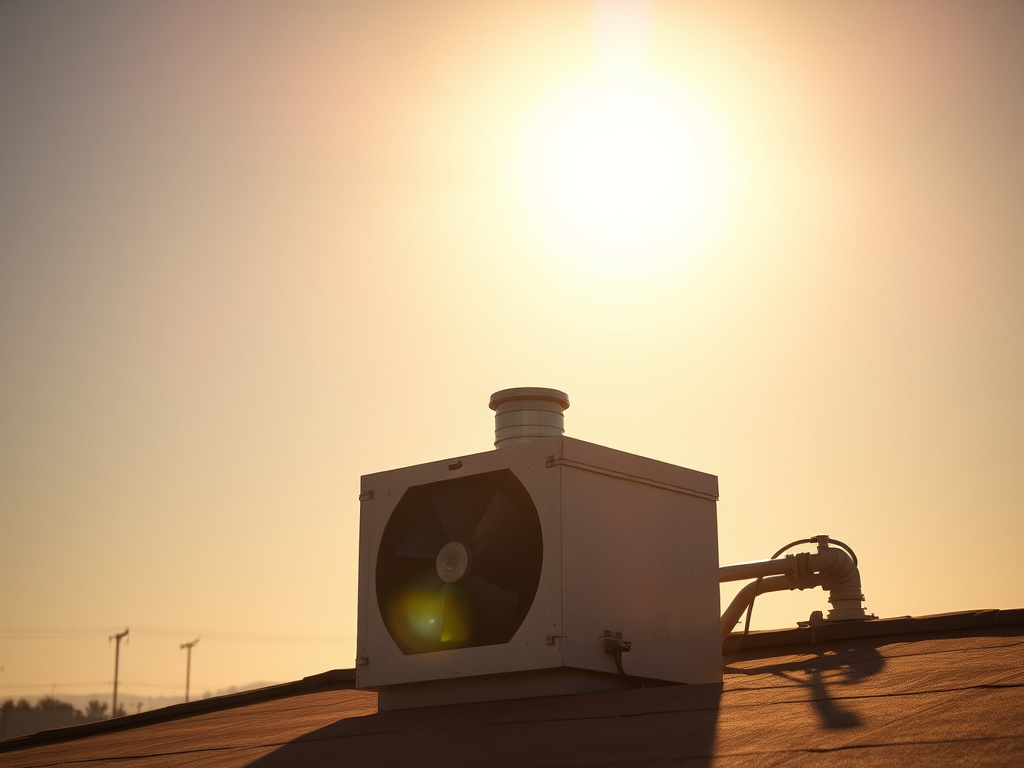
Every commercial kitchen exhaust system deals with grease. That part isn't unique to Phoenix. What is genuinely different here is what happens to that grease once it reaches the rooftop — and if your hood cleaning schedule was designed around generic, climate-neutral guidance, it may not be accounting for a factor that's specific to running a kitchen in the Sonoran Desert.
Rooftop Equipment Runs Hotter Than People Expect
Rooftop exhaust fan housings, duct terminations, and grease containment pans sit in direct sun for most of a Phoenix summer day. Ambient air temperature alone routinely climbs past 110°F across the Phoenix metro in June, July, and August — but the surface temperature of dark rooftop equipment in direct sun runs meaningfully hotter than the surrounding air. Rooftop exhaust components in this kind of exposure regularly reach surface temperatures well above 150°F during peak summer afternoons, on top of whatever heat the exhaust airstream itself is already carrying up from the cookline below.
That's the starting condition every rooftop grease containment system in the Phoenix metro is working against, every single day from roughly May through September.
Why Heat Speeds Up the Buildup Cycle
Grease residue inside ductwork and on rooftop fan housings doesn't behave like a static coating. It goes through a physical cycle as it heats and cools:
During peak heat, grease that has accumulated on hot rooftop surfaces partially liquefies. In a cooler climate, that liquefaction happens rarely, if at all, outside of the exhaust airstream itself. In Phoenix, it happens daily, driven by ambient rooftop temperature alone.
As surfaces cool overnight, that liquefied grease re-solidifies — but not necessarily in the same place it started. It runs, pools, and re-hardens in new areas of the duct interior, fan housing, and containment system, spreading residue into spots that may not have been part of the original deposit pattern from the exhaust airflow.
Repeat that cycle daily across a Phoenix summer, and a rooftop exhaust system can see meaningfully faster grease redistribution and re-accumulation than the identical system, serving the identical menu and cooking volume, would see in a moderate climate. The grease isn't necessarily increasing in total volume faster — it's spreading and re-depositing faster, which changes how quickly containment systems, fan housings, and duct terminations reach a condition that poses real fire risk.
Why This Matters for Fire Risk Specifically
Grease fire risk in a commercial kitchen exhaust system comes down to one core mechanism: a heat source (a flare-up at the cookline, or in rare cases a rooftop ignition source) meeting a fuel source (accumulated grease) somewhere in the exhaust path. NFPA 96's cleaning-frequency requirements are built around keeping that fuel source below a threshold where routine kitchen heat events can't reach it.
The Phoenix heat-cycle effect described above means that threshold can be reached faster on a rooftop system here than the same system would reach it in, say, Denver or Seattle — even on an identical NFPA 96 Table 12.4 frequency tier based on cooking volume alone. A moderate-volume restaurant on a semi-annual cleaning schedule that's appropriate for its menu and hours may still be accumulating rooftop-specific redistribution faster than that schedule was originally designed to catch, purely because of what Phoenix rooftop surface temperatures are doing to the grease between cleanings.
Rooftop Grease Containment Deserves Its Own Attention
Most hood cleaning conversations focus on the hood canopy, plenum, and duct interior — the parts that are visible from inside the kitchen. Rooftop grease containment pans and collection systems are easy to treat as a secondary detail because they're out of sight. In Phoenix, that's a mistake worth correcting.
Grease that escapes containment and reaches an unprotected roof membrane doesn't just create a fire-risk problem — it actively degrades roofing material over time, since petroleum-based grease residue breaks down membrane roofing far faster than plain weathering does. For any restaurant or kitchen operating under a lease, that's a direct cost exposure: a landlord holding a tenant responsible for roof damage traced back to unmanaged rooftop grease is a real and avoidable dispute.
A rooftop-specific inspection — checking containment pan condition, fan housing buildup, and duct termination points — is worth doing as part of your regular service, not as an afterthought once the interior hood and duct work is finished.
What This Means for Your Cleaning Schedule
This isn't a reason to panic or assume every Phoenix kitchen needs monthly service regardless of volume. NFPA 96 Table 12.4 frequency tiers (monthly for solid-fuel, quarterly for high-volume, semi-annual for moderate-volume, annual for low-volume) remain the compliance baseline, and Phoenix Fire Department enforces against that same standard regardless of climate. What the heat-cycle effect means practically is:
- Rooftop containment and fan housing condition are worth checking between full hood cleanings if your kitchen runs on the longer end of its frequency tier (semi-annual or annual)
- A kitchen sitting right at the edge between two volume tiers has a reasonable case for erring toward the more frequent tier, given how much faster rooftop redistribution moves here
- Scheduled maintenance contracts that build in a rooftop-specific check are a more realistic match for Phoenix conditions than a bare-minimum, compliance-only cleaning cadence
Frequently Asked Questions
Does Phoenix's summer heat actually mean my hood needs cleaning more often than NFPA 96 requires? NFPA 96 Table 12.4 sets the legal minimum frequency based on cooking volume and type, and that's the compliance baseline regardless of climate. What changes in Phoenix is how much rooftop-specific grease redistribution can happen between those scheduled cleanings — which is why rooftop containment checks between full services are worth considering here even when your base frequency tier stays the same.
Can rooftop grease buildup actually damage the roof itself? Yes. Grease that escapes containment and reaches unprotected roof membrane degrades that material faster than normal weathering, which is a real cost and liability exposure for tenants operating under a lease.
Is this heat-cycle effect something other Phoenix competitors talk about? It's a genuinely underexplained angle in most hood cleaning content, which tends to be written generically without accounting for climate. It's a real mechanical effect specific to how rooftop exhaust equipment behaves under sustained Phoenix summer sun exposure.
If your rooftop exhaust system hasn't had a dedicated containment and fan-housing check recently, call PHX Hood Vent Cleaning at 844-967-5247 or email josh@contractorschoiceagency.com to request a free quote and get your rooftop system evaluated alongside your next scheduled cleaning.